
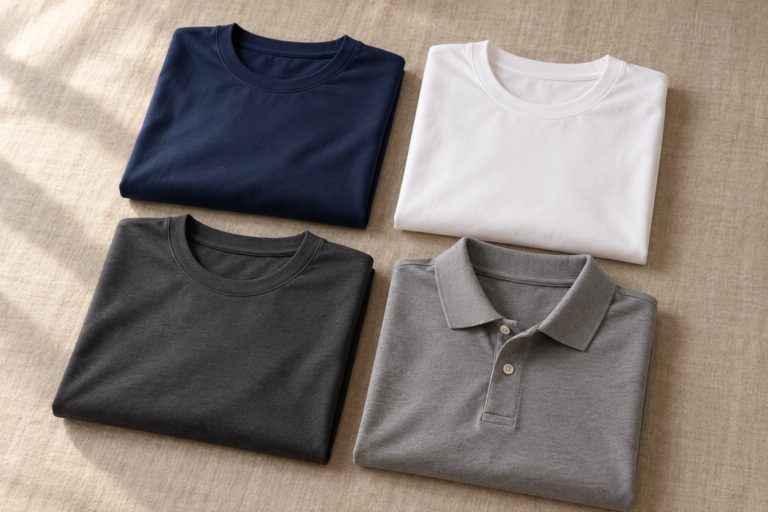
Finding the right private label men’s basics manufacturer starts with a simple question: which piece would your customers buy again without thinking? A solid t-shirt in a color that works with everything beats the boldest graphic in your lookbook. The graphic needs a trend to stay relevant, and once that trend fades, so does the reason to reorder it. A solid never has that expiration date.
That’s the real opportunity here, and together we can help you build it right from the first order.
Key Takeaways
- Solid-color basics are the lowest-risk first order for a new menswear brand. No print approval delays, no seasonal color bets, easy to reorder once you know what sells.
- A solid essential stays sellable long after a trend piece gets marked down. You can run the same production order again next season without redesigning anything, and it will mix into a customer’s existing wardrobe rather than compete with it.
- Pima cotton fits essentials naturally. Durable through repeat wear, soft enough to justify a premium price point over basic cotton blends.
- A good manufacturing partner treats basics as a discipline: consistent dye lots, steady sizing, reorders that actually match the last batch.
Why Solid-Color Basics Are the Safest Bet for a New Menswear Brand
Founders launching their first collection often want to lead with something bold: a print, a graphic, or a statement piece that showcases the brand’s personality. That instinct makes sense creatively. However, it’s also the hardest way to spend a first initial production run, since the success of a print depends on a single bet on what will resonate with the public.
A solid-color essential skips that entirely. There’s no print approval cycle, no guess about which colorway will land, no leftover inventory once a trend moves on. Once you know a fit and fabric sell, you reorder the same thing again, whether that’s a t-shirt or a polo, and each reorder gets simpler than the last.
Which Colors Actually Count as Timeless?
“Solid” isn’t the same as “safe,” especially in menswear. A trend-driven pastel or a vibrant seasonal color can be just as hard to restock a year later as a print. The colors that truly endure across seasons in a men’s collection are those that work in almost any context: black, navy blue, white, and various shades of gray.
At The Pima Company, those colors are available in-stock for both t-shirts and polos. The polo line adds a few more options that stay in the same timeless territory without being purely neutral: white, black, gray shades, navy, among others. Starting with in-stock colors keeps you inside the standard MOQ instead of adding a custom-dye minimum on top of it.
What to Look for in a Private Label Men’s Basics Manufacturer
Many manufacturers can produce a high-quality T-shirt or Polo shirt. Fewer treat it with the same care they would give a flagship garment. The difference shows up in small, specific things: a dye lot that matches between your first order and your fifth, sizing that holds steady instead of drifting batch to batch, and a reorder that ships on the same timeline instead of turning into a new negotiation.
That coherence is also the foundation upon which we have built The Pima Company. We work in 100% Peruvian Pima cotton, an extra-long staple (ELS) fiber, with the same production standards applied to every run, which is part of how we keep a dye lot matching across reorders months apart. Build your first collection around a t-shirt, a polo, or both, and the fabric standard, the team, and the point of contact stay the same as you grow from one order into a repeatable collection.
Curious whether a solid-essentials line fits your brand? Talk it through with our team →
What This Looks Like in Practice
Founders come to this with different starting points. Some are launching a menswear brand from scratch and want a tight, reorderable core collection before they touch anything seasonal. Others already sell one category, say t-shirts, and are exploring whether adding polos rounds out the line without adding real risk.
Before you request a quote or a sample, it helps to have three things ready: 1) the fit you want (even a rough sketch or a reference garment works), 2) how many colors you’re starting with, and 3) whether you’re ordering one style or combining a few under the same minimum. Having these three points clear allows your initial conversation with the manufacturer to result in a more concrete quote, avoiding an endless exchange of messages.
From there, the questions that actually matter will be more about the relationship and less about the spec sheet. Will the color still match if you reorder six months from now? And if your point of contact ever changes, is the order simple enough for someone new on the team to pick up without starting over? That’s why basics are a lower-risk category in general: there’s less to relearn than with a complex, multi-piece collection. Those are the things that determine whether a basics line is efficient to manage or becomes a constant headache.
Ready to plan a core collection built to last? Get in touch with our team →
Frequently Asked Questions
1. What is the MOQ for a private label men’s basics manufacturer like The Pima Company?
300 units, mixable across styles, sizes, and colors, with a 10-unit minimum per SKU, using in-stock fabric colors.
2. Do t-shirts and polos use the same fabric?
Yes. Both run in 100% Pima cotton Interlock at 180 GSM, which is part of why combining both in a first order is straightforward: you’re working with one fabric standard, not two.
3. Is Pima cotton worth it for basics?
A solid essential gets worn and washed more than almost anything else in a customer’s rotation, so fiber quality determines whether it still looks good six months in.
4. How long does production take for t-shirts or polos?
10 to 12 weeks from approved sample using in-stock fabric.
5. Do you work with other fabric weights, like jersey?
Yes. And if you want to work with a blend, the minimums are around 800 units.
For more on how Peruvian Pima cotton compares across fabric types, see our article on choosing the right fabric weight, and for more on private label manufacturing fundamentals, see our guide on private label clothing manufacturing. If you are also comparing polo programs, see how we work as a custom polo shirt manufacturer.
The Pima Company has manufactured private-label basics, sleepwear, and kids’ clothing for US brands since 2009. Our Lima, Peru facility produces t-shirts and polos on the same consistent Pima cotton sourcing, order after order.