
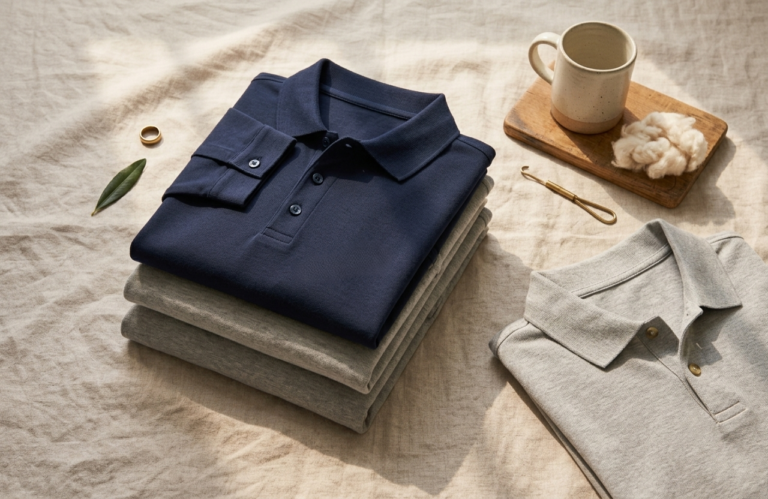
If you’re sourcing custom polo shirts for a golf brand, a corporate apparel line, or a private label collection, most manufacturers you’ll find online are working with synthetic performance fabric. That’s a real gap for founders who want something different: a natural fiber polo that still holds its shape and performs.
This guide explains what to look for in a custom polo shirts manufacturer, how Pima cotton compares to synthetic golf apparel, and the real numbers behind MOQs, timelines, and branding.
Key Takeaways
- Most polo shirt manufacturers default to synthetic performance fabric. Peruvian Pima cotton is a real alternative for brands that want a natural fiber feel without giving up structure.
- Interlock and Jersey are not interchangeable. Pima Interlock is heavier and more structured, built for a polished look. Pima Jersey is lighter, built for a casual, everyday feel.
- Two MOQ paths exist: 300 units from in-stock fabric (8 to 10 weeks), or 800 units per color for a custom-dyed blend (14 to 16 weeks).
- Embroidery and branding are built into the process, not an add-on you have to source separately.
Why Founders Are Looking Beyond Synthetic Polos
Search almost any “polo shirt manufacturer” and the results lean toward moisture-wicking polyester built for golf performance wear. That fabric works for tour-level athletic use.
It’s a different story for brands positioning around comfort, quality, or a natural fiber story. A cotton polo with the right construction can compete on performance while telling a completely different brand story.
At The Pima Company, every polo starts with 100% Peruvian Pima cotton. Its extra-long staple fiber averages 38mm, compared to the 25 to 28mm of standard cotton. In practice, that means a softer hand feel, less pilling after repeated wear, and a shirt that holds its shape wash after wash.
Pima Interlock vs. Pima Jersey: Choosing the Right Construction
The fabric construction you choose changes how the finished polo looks and feels, and it’s a decision that should happen before sampling starts.
Pima Interlock runs on the heavier side of our fabric range, between 180 and 220 GSM. It has a more structured, tailored feel that holds its shape on the shelf and on the body. This is the construction most brands choose for a polished, premium-positioned polo.
Pima Jersey is lighter weight and drapes more like a t-shirt. It gives a softer, more casual feel, better suited to everyday wear or brands leaning into a relaxed aesthetic.
Neither is better. The right one depends on how your brand wants the polo to sit and what price point you’re targeting.
The Opportunity in Golf and Corporate Apparel
Golf and corporate apparel brands often assume performance fabric means synthetic fabric. It doesn’t have to.
A well-constructed Pima Interlock polo delivers structure, breathability, and durability, the same qualities brands look for in performance golf wear, without the synthetic feel. For corporate gifting and team uniform programs, that natural fiber story is also a differentiator when every other vendor is offering the same poly-blend option.
We’re seeing more inquiries from brands in this exact position: they have a reference photo of a polo they like, but no tech pack and no clear sense of where to start. That’s normal. Part of what a manufacturing partner should do is help you translate a reference image into a real production spec.
Have a reference polo in mind but no tech pack yet? click here
MOQs, Custom Blends, and Timelines
There are two ways to source Pima cotton polos, and the right one depends on how much color and fabric customization your brand needs.
In-stock fabric: 300 units per order, divided across sizes, styles, and colors, with a minimum of 10 units per SKU. Timeline runs 8 to 10 weeks from approved sample.
Custom-dyed fabric: For brands that need an exact brand color rather than one of our in-stock shades, the minimum rises to 800 units per color. Timeline runs 14 to 16 weeks, since the fabric has to be dyed and tested before cutting begins.
Whether you’re stocking for spring and summer golf season or building inventory ahead of Q4 corporate gifting, the production math stays the same. Ordering 8 to 10 weeks (or 14 to 16 weeks for custom color) ahead of your target delivery date is what keeps a launch on schedule instead of scrambling.
Our Lima, Peru facility produces up to 40,000 polos per month, which means capacity isn’t the constraint. Planning ahead is.
Branding: Embroidery, Labels, and Packaging
A polo shirt is one of the easiest garments to brand well, and it’s often where a private label line starts to feel like a real product line instead of a blank shirt.
Industrial embroidery is available for logos, and our team can advise on placement, thread count, and stitch density based on your logo’s complexity. Woven labels, neck tags, and custom packaging round out the private label package, all built into the same production run rather than sourced separately.
Ready to build your polo shirt line?
Connect with our team
Frequently Asked Questions
- What is the MOQ for a custom polo shirts manufacturer like The Pima Company?
300 units per order using in-stock fabric, split across sizes, styles, and colors with a 10-unit minimum per SKU. Custom-dyed color requires 800 units per color. - Is Pima cotton a good fabric for golf polos?
Yes. Pima Interlock offers the structure and breathability golf brands look for in performance fabric, with a natural fiber feel that synthetic poly-blends don’t have. - What’s the difference between Pima Interlock and Pima Jersey for polos?
Interlock is heavier and more structured, suited to a polished, premium look. Jersey is lighter and drapes more casually, suited to everyday wear. - How long does it take to manufacture custom polo shirts?
8 to 10 weeks from approved sample using in-stock fabric. Custom-dyed color adds development time, running 14 to 16 weeks total.
For more on how Peruvian Pima cotton compares across fabric types, see Cotton Incorporated’s guide to fiber quality, and for a full breakdown of our manufacturing process, see our guide on private label kids clothing manufacturing.
The Pima Company has manufactured private label apparel for US brands since 2009. Our Lima, Peru facility produces polo shirts, t-shirts, and men’s basics with an MOQ of 300 units per purchase order.